Alternating Current Circuits
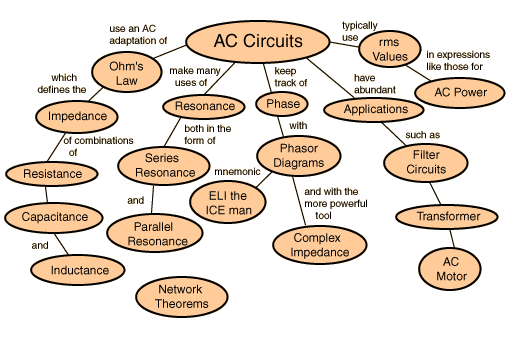
Equations to remember:
when an AC Circuit switch is closed, we have a charging circuit, and:voltage across the inductor equals 0, and delta V = 0
- instantaneous voltage and current are 90 degrees out of phase, where V lags behind I within the capacitor
- instantaneous voltage and current are 90 degrees out of phase, where V leads I within the Inductor
- voltage is IN PHASE With the current, within the resistor
DeltaVoltageAVG = 1/2VAVG
DeltaVrms = DeltaVmax / sqrt(2)
Inductive Reactance: XL = ωL
Capacitive Reactance: XC = 1/ωC
TOTAL reactance of an RLC circuit:
XL - XC = Rtan(theta)
theta = angle I is leading V
impedance (Z): Impedance is ...?
Z = SQRT(R^2 + X^2)
Z = V / I
NOTE: V and I are complex sinusoidal functions for voltage and current
**when you have an AC (Oscillating voltage) Circuit that only contains an INDUCTOR,
I = Vrms / ωL
**when you have an AC (Oscillating voltage) Circuit that only contains an CAPACITOR
I = V / XC
I = VωC
The PHASE ANGLE..
in a series RLC circuit the phase angle is given by: tan(theta) = (XL - XC/R)
at resonance, Inductive Reactance equals the Capacitive Reactance:
XL = XC
Phase angles are frequency dependent~!
Power in an electric circuit
RATE OF power delivered (or work done by power) = (frequency) ( voltage)
when F and V are vectors..
P = FVcos(theta)
Quality Factor (Q)
Q tells you how underdamped an oscillator is In physics and engineering the quality factor or Q factor is a dimensionless parameter that describes how under-damped an oscillator or resonator is,[1] or equivalently, characterizes a resonator's bandwidth relative to its center frequency.[2] Higher Q indicates a lower rate of energy loss relative to the stored energy of the resonator; the oscillations die out more slowlysource: Wikipedia
Capacitance for an AC-circuit?
UNIT for C = FARADS (F)
C = 1/[4(pi)^2*frequency^2*(L)]

No comments:
Post a Comment