Previously, we have only studied time dependent situations (Maxwell's 4 equations and the Lorenz Force)
^Electric and Magnetic fields always obey these rules for time INdependent situations^
E fields analyzed in this situation are conservative forces: that is why the surface integral of E dot dl equals zero! *image required here
This chapter introduces TIME DEPENDENT situations!
If we have a situation where either the scalar quantity for Charge Distribution (UNIT: Coulombs/meters^3) or the vector quantity for Current Density (Unit: Amps/meters^2) changes, then, we have a time dependent situation! Now, we have a non-conservative electrical field to deal with!Faraday's "Law" of induction:
Basically, the "law" states that when you move a charged closed loop/coil around/across a magnetic field, (where the movement of the object is in the same plane as the loop) an INDUCED CURRENT will create its own magnetic field!
THEREFORE: we have our Initial Current, I, and our Induced Current, i
AND: we have our Initial Magnetic Field, B, and our Induced Magnetic Field, b
- The "law" is written as:
.jpg)
- And we define emf as:
Where F is the Lorentz force. When the movement of an object is NOT in the same plane as the loop, we use the Lorentz force!
pictorial summary of facts:
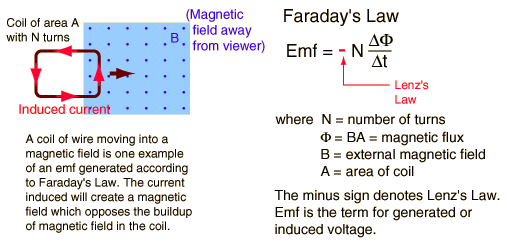
Image is from the following awesome physics website:
recall:

for a uniform field and area, flux = BA when B and A are perpendicular
...SO why did we put "quotes" around the word law?
Because Faradays "law" only works when we are analyzing the velocity of a time dependent object that is moving in the same field as the current carrying loop. This 'situation' commonly occurs - but - does NOT ALWAYS occur!
What about other situations?
WE KNOW THAT changing the magnetic field changes the electric field
WE KNOW THAT changing magnetic flux (B field or the area) induces an emf
WE KNOW THAT the existence of an emf + wire = Current (I)
SO Faraday's equation is not always able to "SEE" a current.
recall,
When the movement of an object is NOT in the same plane as the loop, we use the Lorentz force!

OR, we can use the............
Maxwell-Faraday Law: A Fundamental Law of Nature!
...A summary of the methods voltage can be generated by changing the magnetic field or flux...
Maxwell derived this by combining Faraday's "law" and the definition of emf to hold true for all situations!
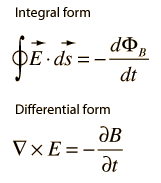
the Maxwell-Faraday equation does not equal zero!
the Maxwell-Faraday equation does not need a physical LOOP of wire, you can analyse the situation with an imaginary loop/path
DEFINITION of Faraday's "Law"
A changing flux induces an emf, or potential difference, in a loop. Whenever we have a potential difference we have an electric field. If the potential difference is the induced emf, we get:
e = ò E ds
The integral should be carried out over a closed loop so we can bring in the changing flux in that loop:
e = -dFB/dt
This gives, integrating around a closed loop, the general form of Faraday's Law:
ò E ds = -dFB/dt
Electric fields produced by changing magnetic fields have some interesting properties:
e = ò E ds
The integral should be carried out over a closed loop so we can bring in the changing flux in that loop:
e = -dFB/dt
This gives, integrating around a closed loop, the general form of Faraday's Law:
ò E ds = -dFB/dt
Electric fields produced by changing magnetic fields have some interesting properties:
- the electric field lines are continuous loops
- the electric field is non-conservative
TO conclude, we have to visit the topic of the conservation of energy - since we started this blog discussion on equations that describe time dependent situations as NON conservative..
LENZ'S LAW is a statement about the conservation of energy in time dependent situations
- The current produced from a time dependent situation always works against the action/movement/flow that created the change in flux.
in other words: the induced current cannot be in the same direction as the original current.
"Eddy Currents" are a result of this...to be continued...


.jpg)

.jpg)


.jpg)


 from t=o to t=end